
Washington County Museum of Fine Arts is Second North American Venue for The Scandinavian Home: Art and Identity, 1880–1920
Washington County Museum of Fine Arts is Second North American Venue for The Scandinavian Home: Art and Identity, 1880–1920
Hagerstown, MD — The Washington County Museum of Fine Arts (WCMFA) is pleased to present The Scandinavian Home: Art and Identity, 1880-1920, a landmark exhibition exploring the rich visual culture of the northern European countries Denmark, Finland, Norway, and Sweden.
This first North American presentation of its kind examines how Nordic artists celebrated the concept of home, national identity, and personal expression during a period of profound cultural transformation. The exhibition will be on view from February 7 to May 17, 2026.
The exhibition opening weekend honors the Swedish tradition of fika (coffee break) with a barista from local favorite Cannon Coffee mixing Swedish inspired coffee beverages from 11-3 on Saturday, February 7 and Sunday, February 8. On Saturday, With Hands and Hearts Antietam Fiber Artists, The Weavers’ Roundtable, and Hagerstown Chapter of Embroiders’ Guild of America will be on site demonstrating traditional rug hooking from 10:30 AM – 4 PM. Exhibition tours and gallery talks will take place throughout the weekend. For more details see: wcmfa.org/the-scandinavian-home-art-and-identity-1880-1920/
The Exhibition
The exhibition features work drawn from the private collection of Dr. David and Susan Werner as well as the public collections to which they have donated works. Paintings, textiles, ceramics, furniture, silver, and other decorative arts illuminate the region’s commitment to individual creativity, local craftsmanship, and national pride. A central unifying metaphor for the exhibition
is a concept of home that encompasses not only an individual’s household, but their home town and homeland—an expansive definition that includes the communities that influence individual development, reflecting a larger vision of social and cultural identity.
In Scandinavian countries, as elsewhere around the turn of the twentieth century, artists and artisans began rejecting the formulaic instruction of state-sponsored academies in favor of personal expression, integrating local landscapes, folk tales, and mythological motifs into their work. Artistic practices flourished across social classes, exemplified by rural families who created decorative furniture, textiles, and household objects, often following long-standing traditions and passing skills from one generation to the next. As in many areas impacted by the growth of cities and the industrial revolution, particular craft traditions became a source of national pride. Reform movements and organizations, including the Swedish Friends of Handicraft, mobilized women to preserve and elevate these traditions, reinforcing a sense of shared cultural heritage and social responsibility.
In Hagerstown, the exhibition takes on particular significance because museum founders, artist William Henry Singer, Jr. and his wife, Anna Brugh Singer, built a home in Olden, Norway. His deep connection to the dramatic Norwegian landscape was expressed in many of his paintings featuring snowcapped mountains, rushing rivers, and villages tucked into snowy drifts. The Hagerstown presentation will also be supplemented with works from the museum’s collection, including examples of Swedish glass, and etchings by internationally acclaimed Swedish artist Anders Zorn (1860-1920).
Executive Director Sarah Hall notes, “This is a rich and fascinating exhibition that dovetails beautifully with the story of our founders and their attraction to life in Norway. I had the pleasure of seeing much of this collection in the Werners’ home some years ago, and I am absolutely delighted that we are able to bring these works and the story they tell to Hagerstown.”
What Visitors Will See
The exhibition includes more than 80 objects and is organized into thematic sections: Norwegian Revival, An Artist’s Home/Art Nouveau, Vitalism in Finland and Denmark, Symbolist Experimentation, Rural Craft Traditions, Interiors, and History of Landscape.
 The entry gallery immerses visitors in the Norwegian Rival—with works inspired by medieval history and folk traditions. The tapestries of Gerhard Munthe (Norwegian, 1849-1929) and the furniture of Lars Kinsarvik (Norwegian, 1846-1925) embody a tradition populated by princesses, trolls, dragons, and magic. A number of Munthe’s works are in the exhibition, including his tapestry The Suitors, which depicts a fairytale of Munthe’s own invention in which three young men, transformed into polar bears, enter the chambers of the daughters of the Northern Lights to court them. Munthe first created a series of independent watercolors in 1893 with no plans to reproduce them in textiles, and later adapted them for production by students at the newly established Art Weaving School, in the National Museum of Decorative Arts in Trondheim, Norway. Munthe’s designs combine rural Norwegian craft traditions with the influence of Japanese design and Art Nouveau and are characterized by bold lines, flattened forms, and bright colors. The tapestries garnered international attention after their display at the 1900 Paris World’s Fair.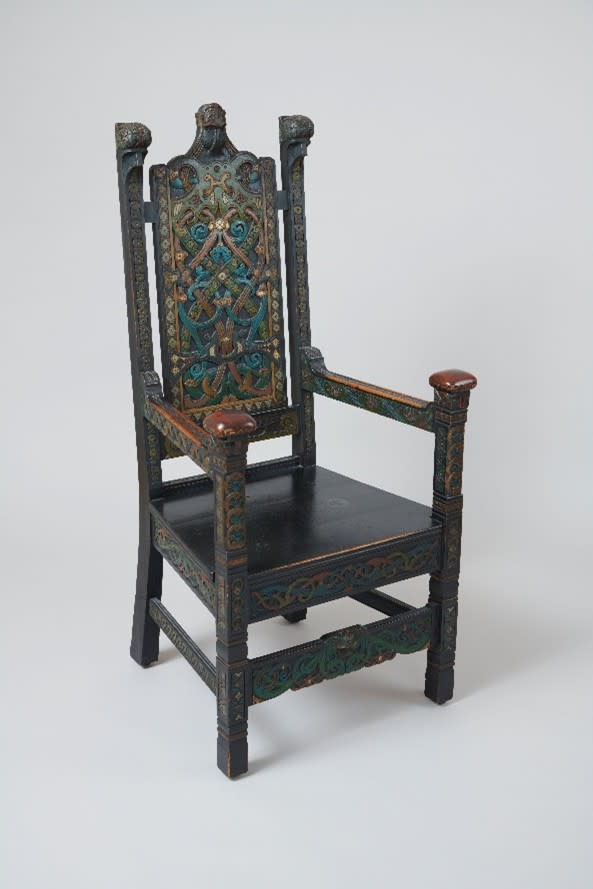
Also receiving international attention at the World’s Fair was Lars Kinsarvik’s elaborately carved armchair, a delightful (if imposing) demonstration of what became known as “Dragon Style.” One of Norway’s leading wood carvers, Kinsarvik also popularized the use of colors derived from regional peasant decoration.
In Norway, artists, writers, and designers drew inspiration from medieval history and folk traditions, shaping a modern national style that included both architecture and interior decoration. Artists designed their homes as models of a new way of living—reflecting not only personal taste, but social ideals, and respect for the local environment. As in other manifestations of the Arts and Crafts Movement, particularly in England and America, interiors were adorned with handcrafted objects, textiles, and artworks, that conveyed comfort, family life, and democratic principles, reflecting the belief that one’s surroundings could positively influence well-being and society as a whole.
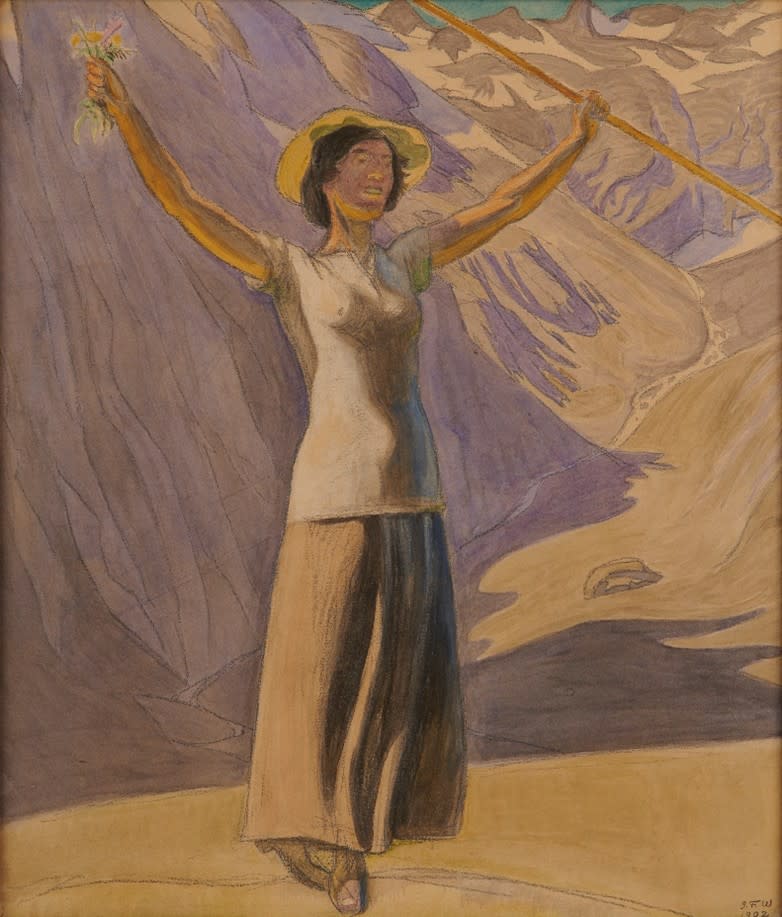 As the 20th century dawned some artists were attracted to a movement known as Vitalism, which advocated physical health and wellness through time spent outdoors, exercise, sunlight, and fresh air. The works of Jens Ferdinand Willumsen (Danish, 1863-1958) and his subjects including beach scenes, water, and dazzling sunlight exemplify Vitalist interests. His Lady Mountaineer seems to celebrate a sense of freedom and liberation in the outdoors as the female figure, against a painterly backdrop of jagged mountains, raises her arms above her head in a gesture that communicates triumph, pleasure, and power.
Renowned artist Edvard Munch (1863-1944) himself participated in the Vitalist movement, although he is best known for Symbolist works that embody psychological and existential angst. In the exhibition his print Omega’s Flight reflects this better-known vein of Munch’s work and joins examples by Hugo Simberg (Finnish, 1873–1917) and others in representing the concerns of artists involved in experimentation and the growing modern Symbolist movement.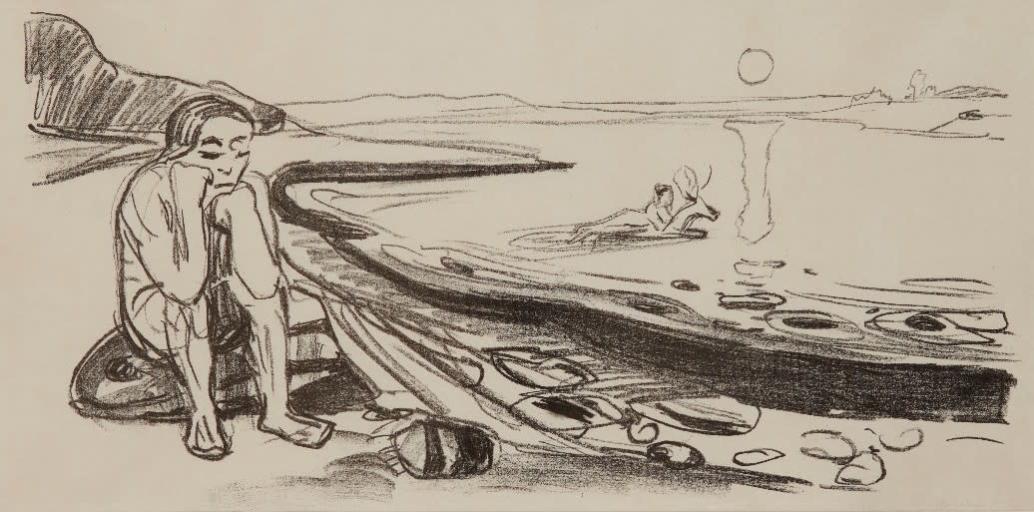
Artists also sought to convey the unique beauty of their homelands, from luminous Northern skies and rugged fjords to snow-covered hills and waterways. Landscapes were not only aesthetic subjects but also symbols of national identity, reflecting the physical and cultural environment of each country. Many artists studied abroad in Germany or Paris, then returned home and used their skills to celebrate their native landscapes, contrasting the Nordic natural world with the Continent and defining a distinctive regional style.
 Sunset in Värmland by Otto Hesselbom (Swedish, 1848-1913) captures the glow of the setting sun as it dips beneath distant hills and imparts an orange glow on the landscape. Undulating bands of snow are dramatically contoured and contrasted with the dark vertical forms of trees, creating a scene that conveys both isolation and coziness. During midwinter at this latitude, the sun never rises far above the horizon, and sunset occurs in the early afternoon. This phenomenon produces intensely saturated colors in the sky, like nothing audiences in southern Europe had ever experienced. Hesselbom sought to capture this phenomenon and connect with Swedish viewers through the elevation of the wild, sometimes inhospitable, but uniquely beautiful Nordic nature.
Swedish artists, many of whom studied in Paris, brought back with them a commitment to publicly accessible art, social engagement, and national pride. They sought to foster empathy and solidarity through paintings, public commissions, and decorative works, contributing to the social democratic ideals that continue to thrive in the Nordic countries today.
Artists’ collectives, such as Sweden’s Rackstad Colony, demonstrate the collaborative spirit and experimental creativity of the period. Located near Lake Racken in Värmland, the colony fostered cooperative living and produced works across a wide range of media, from sculpture and ceramics to furniture and textiles. Inspired by the National Romantic ideals of nature, folk culture, and the past, these artists embraced local traditions, egalitarian values, and a profound connection to nature.
“The exhibition offers a rare opportunity to see Scandinavian art in dialogue with the local history of our museum,” said Agnita M. Stine Schreiber Curator, Linda Johnson, Ph.D., “Visitors can explore how international developments in Nordic art connect to our museum’s founders and their deep engagement with Norway’s landscape and culture.”
Organizational Credit
The Scandinavian Home is curated by Patricia G. Berman and Michelle Facos. The national tour has been organized by Dawn R. Brean, Chief Curator and Director of Collections at The Frick Pittsburgh.
The Hagerstown presentation has been made possible through the generous support of Paul Mellott, with additional support from the John R. Hershey Jr. and Anna L. Hershey Family Foundation and Dr. and Mrs. Robert K. Hobbs.
The exhibition is accompanied by a fully-illustrated color catalogue available in the Museum Store.
Associated Programs
A variety of engaging complementary programs are scheduled to enhance enjoyment of the exhibition. Check wcmfa.org, or the museum’s social media pages for more details on programs.
ABOUT THE WASHINGTON COUNTY MUSEUM OF FINE ARTS
Located In beautiful City Park, Hagerstown, Maryland, the Washington County Museum of Fine Arts was founded in 1931, the legacy of Hagerstown native Anna Brugh Singer and her husband, Pittsburgh-born artist William Henry Singer, Jr. Featuring a collection of more than 8,000 objects, the museum has important holdings of American painting, Old Masters, decorative arts, and sculpture. The museum schedules an ambitious program of exhibitions, lectures, concerts, tours, and talks featuring national and international artists, as well as a yearly showcase of the art of students in Washington County Public Schools. Its free youth art education programs have served seven generations of local families.
GENERAL INFORMATION
Washington County Museum of Fine Arts is located at 401 Museum Drive, Hagerstown, Maryland. Free parking is available adjacent to the Museum. Hours are 10:00 a.m.–5:00 p.m., Tuesday – Sunday; the museum is closed Mondays and major holidays.
Exhibition Admission
The Washington County Museum of Fine Arts has been FREE to the public since 1931.
For additional information, images, or interview requests, please contact Bailey Rafter at 301-739-5727 or brafter@wcmfa.org.
Additional Info
Media Contact : Bailey Rafter, Manager of Marketing and Publications; 301-739-5727; brafter@wcmfa.org